
Your Tech Stack Isn’t the Problem. The Disconnect Is.

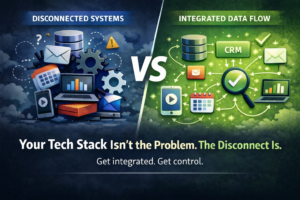
Most organizations have a tech stack.
However, far fewer have a strategy for how their systems actually work together.
At first, that might not seem like a big deal. But over time, that gap is what creates friction across your entire organization.
A Tech Stack Is Just the Starting Point
Your tech stack is the collection of systems you rely on every day.
Your AMS. Your CRM. Your event platform. Your email tool. Your learning system.
Each one plays a role. Each one solves a specific problem.
But simply having those tools in place does not mean they are working together in a meaningful way.
The Real Issue Is How Data Moves
A true tech strategy focuses on one thing above all else.
Data flow.
Where does your data originate?
How does it move between systems?
What triggers updates?
What happens when something changes?
If you cannot answer those questions clearly, your systems are not connected in a way that supports your team.
Instead, your team ends up filling in the gaps.
When Systems Don’t Connect, People Step In
Without a clear integration strategy, manual work takes over.
Teams export data. They re-enter information. They validate reports across multiple systems.
At first, those steps feel manageable.
However, over time, they introduce delays, inconsistencies, and risk.
More importantly, they pull your team away from higher-value work.
Integration Is Not Just a Technical Task
A lot of organizations think of integration as a one-time project.
Connect system A to system B and move on.
But real integration is not just about connecting APIs.
It is about defining how your systems should behave together.
For example:
- Which system owns the data
- When records should be created or updated
- How duplicates are handled
- What should happen in edge cases
Without that level of clarity, integrations can exist and still fall short.
What Better Looks Like
When your systems are aligned through a clear integration strategy, things change quickly.
Data moves automatically and consistently.
Your team stops chasing information.
Reports become easier to trust.
Processes become easier to scale.
In other words, your stack starts to function like a system, not a collection of tools.
Start with Connection, Not Replacement
When something feels broken, the instinct is often to replace a system.
Sometimes that is necessary.
However, more often, the issue is not the tool itself. It is how that tool connects to everything else.
Improving integration and data flow can unlock value from systems you already have.
Final Thoughts
A tech stack gives you capability.
A tech strategy, supported by strong integrations, gives you control.
And that control is what allows your organization to move faster, operate more efficiently, and make better decisions.
As associations expand their technology ecosystems, seamless integrations become critical for operational efficiency. Learn how Data Sangria helped connect MemberSuite and EventsAir for OASBO to automate event and registration data synchronization while supporting a more connected association technology stack.
Struggling to keep YourMembership and Salesforce in sync? Learn how Data Sangria connects your systems, automates data flow, and gives your team a single, reliable source of truth.

Advocacy success depends on action, not just opens. Learn how experimentation, A/B testing, and integrated data help optimize campaign and turn insights into measurable data.